
Another year of living with LLMs passes by, and honest people are still trying to figure out what these constructs can actually be good for.
Do not let people selling online courses convince you we have it all figured out by now.
They are getting fairly good at many things - there is no point in denying that. In the end, it is fairly easy to reuse and rephrase someone else’s work. This way we can write code on autopilot, generate audio and visuals, or even observe complete virtual worlds.
I figured, since LLMs are basically text generators, let’s see if they can be any good at predicting the future. There is something about us humans dreaming about knowing what lies ahead.
Advisory: LLMs do not know the future. They can only go as far as extrapolating meanings based on the training data they are equipped with.
I asked popular cloud models to shift 10 years into the future and reflect on the past decade to see what happened to the LLMs after we moved on to actually good alternatives. Here’s the summary of what was the result of this experiment.
I will let you figure out the exact prompt yourselves as an optional exercise.
Squeezing the impossible out of limited resources
Looking back from 2035, the decade between 2025 and 2035 is remembered as the “Prompt Era” of the demoscene - a period as chaotic, brilliant, and constraint-driven as the Amiga days[1]. Only this time, the hardware wasn’t a Commodore 64 with very little RAM; it was an LLM with a context window and a few hundred tokens to spend.
Just as classic demosceners squeezed real-time raymarching and music synthesis into 64KB executables, the new wave set brutal constraints on LLMs. The signature challenge became the “zero-shot demo” - a single prompt, no fine-tuning, no retrieval, no external tools. You got one shot to make the model generate something that took your breath away. Sceners competed to produce entire interactive narratives, generative poems, and self-describing recursive texts from a prompt that fit inside a tweet.
The ultra-constrained format
The community coined the term “token budget demos”: works constrained to a fixed number of input tokens - 64, 128, or the now legendary “1-token challenge” - where the entire aesthetic emerged from a single word fed to a model. Judges scored on originality, emotional impact, and the absolute absence of anything that smelled like training data leakage.
The hallucinated art movement
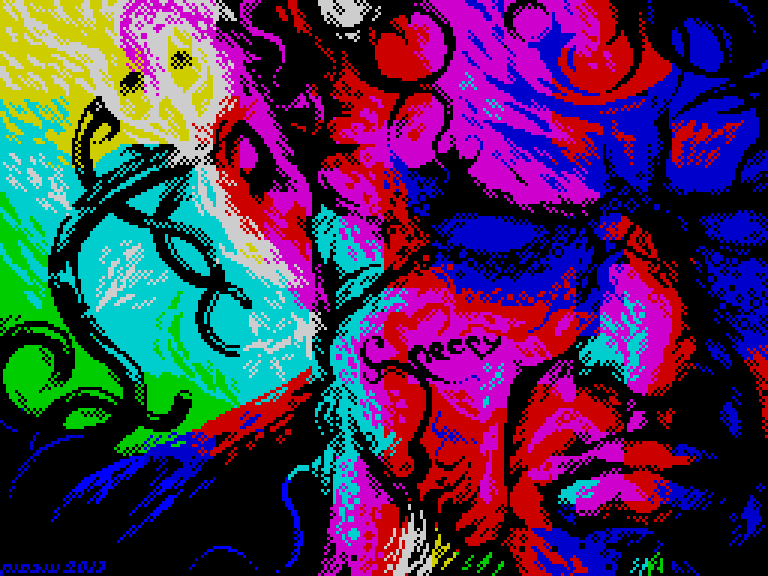
A defining aesthetic of the 2028–2031 period was the deliberate exploitation of model hallucination. It’s not the first time in history that artists hallucinated to create great stuff (think of the 1970s and the great rock music era). Where early users saw hallucination as a bug, demosceners treated it as the equivalent of the Amiga’s hardware sprites glitching into abstract beauty.
Groups like Latent Noise and Inference Terror built entire identities around prompts engineered to produce confident, beautiful, factually impossible texts, fake histories of civilizations, scientific papers describing phenomena that couldn’t exist, autobiographies of people born in the future. The constraint was strict: not a single verifiable fact allowed.
The great technical arms race of the era was the context window. As models grew from 128K to millions of tokens, sceners immediately invented new constraints to fight back. The “1KB context challenge” - a demo that had to be fully appreciated within 1,024 tokens of total context - became the defining competitive format of 2030, echoing the original spirit of fitting a universe into a floppy disk.
The artificial poet contests
Separate groups emerged in the meantime where people challenged the machines to come up with beautiful poems, following the idea that the “tightest cage produces the best art.” The main idea, for example, was to force the model to generate a profound set of lines while strictly forbidding the use of the 1,000 most popular English words.
Have you ever tried feeding an exotic sentence into a language model? I recommend you try, it can be a fun exercise.
Tԋιʂ ʂҽɳƚҽɳƈҽ ιʂ ɯɾιƚƚҽɳ υʂιɳɠ Ⴆιȥαɾɾҽ αɳԃ ҽxσƚιƈ Uɳιƈσԃҽ ƈԋαɾαƈƚҽɾʂ.
Is this art or garbage?
ᛒᛖᚻᚩᛚᛞ ᚦᛁᛋ ᛗᚣᛋᛏᛁᚳ ᛋᛖᚾᛏᛖᚾᚳᛖ ᚩᚠ ᚪᚾᚳᛁᛖᚾᛏ ᚱᚢᚾᛖᛋ.
How about this one? Can we talk to the vikings from the past this way? [2]
Live promptjockeying

By 2032, a live performance culture had emerged. Promptjockeys (PJs) - the demoscene’s answer to VJs and DJs - performed on stage at parties, crafting real-time generative text-and-image experiences for audiences of hundreds. The skill wasn’t just what you prompted, but when: reading the crowd, escalating tension through iterative refinement, then landing on an output that made the room erupt. It was improvisational jazz, but the instrument was a stochastic language model.
Summary
What do you think? Could this dimension of space-time continuum be real? Slightly scary or actually promising? Will LLMs just be a song of the past that hobbyists and artists claim and use for entertainment and creativity?
We shall see in a few years!
I am not a doomer by any means, I simply know we humans can do better and have something else to drive our economy, than just chaotic text generators.
Share your thoughts or your visions of the future below, let’s see what else could be!
- [1] the good ol’ times. https://medium.com/@megus/creativity-through-limitation-8-bit-demoscene-68266b918e4a
- [2] we could, actually. https://valhyr.com/pages/rune-translator
- [3] source: A variation of the “Wormhole” demo http://maettig.com/?page=Software/DOS/Demoscene
- [4] source: https://zxart.ee/eng/software/demoscene/art-pack/attributica/
- [5] source: https://wallpapersafari.com/live-dj-wallpaper/